

Part 2 of the series "The Stages of AI Use in Detail" – Stage 3: Connecting to real tools and data. An overview of all six stages is available in the introductory article.
Continued from Part 1: The fixed social media assistant knew its rules, but not my real data. What came next can be pinned down to a single, fairly concrete moment.
I opened the article, saved the image, copied the text, pasted both into another window – and did it by hand every single time. Until the day an agent was able, for the first time, to fetch a blog article on its own via the REST API, extract its featured image and automatically insert it as a link preview into a social media post. The same task, suddenly one single operation instead of four.
- The manual chore I used to repeat for every post
- The tool the agent has been using ever since to fetch the data itself
- The
links_pagerequirement as an example of a rule that only came about because of a mishap - Why "multi-step without asking" is not the same as "unlimited"
Before: Me as the clipboard
Up to this step, this is how it went, for every single post:
Open the finished blog article in the browser.
Download the featured image and store it locally.
Copy the title and link to the clipboard by hand.
Manually paste the image and text into the social media tool.
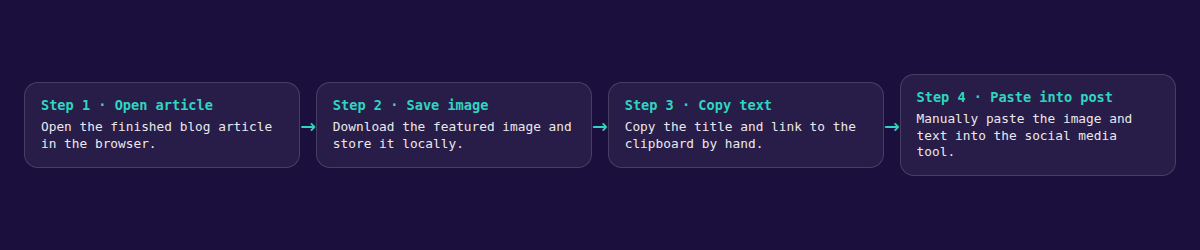
Before: four manual steps per post.
Four manual steps, starting over with every post. At this point I wasn't the decision-maker but the agent's tool – it supplied the text, I supplied the data to go with it.
The step: A tool instead of an instruction
At Stage 2, the AI works exclusively with what I write into the prompt. At Stage 3, the agent instead gets a tool of its own, which it uses to obtain the missing data itself:
Tool: artikel_holen(url)
Returns an article's title, excerpt, link and featured image via the WordPress REST API.
Instruction:
When a post about a blog article is to be created, fetch the article yourself
using artikel_holen. Use the featured image as the post's link preview.
Don't ask for the image or link if the article provides both.
Behind the scenes, this tool queries the same public standard endpoint that any browser uses when it loads the page – the back door through which programs can read a WordPress article:
GET /wp-json/wp/v2/posts?slug=[artikel-slug]&_embed
→ title.rendered, excerpt.rendered, link
→ _embedded["wp:featuredmedia"][0].source_url (= featured image)
The most important sentence in the agent prompt is the last one: "Don't ask." It shifts the work from me to the agent – but only for obtaining the data, not for deciding what happens with it.
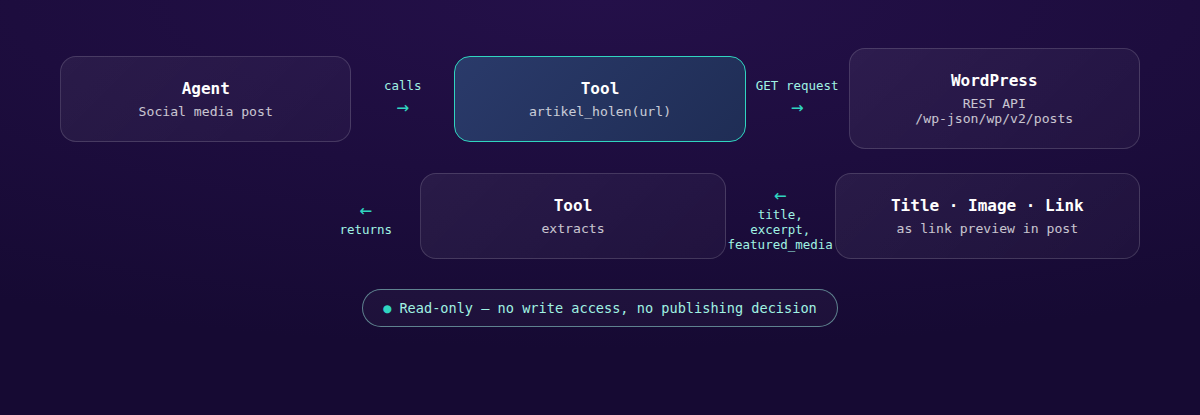
Architecture of stage 3: the agent calls its own tool, which queries the blog's interface in read-only mode.
How tightly the boundaries are drawn
What matters here is not the connection itself, but how narrowly it is scoped. Access is read-only: there is no write access via this route, no way to change content, only to retrieve it. Within this narrow boundary, the agent may then carry out several steps without asking – recognize the article URL, query it, extract the title and image, insert them into the preview. This corresponds to level A2 Delegated on the MIT autonomy scale: a limited goal, several steps, but fixed outer boundaries.
A rule that grew out of a mishap
How narrowly this connection has to be scoped in practice is shown by the links_page requirement. Every social media post is supposed to point to a matching target article. In one post this reference was missing, which is why the associated overview page was not updated. Since then, the program actively searches the prepared texts for a matching article URL, automatically fetches the title, URL and featured image via the same tool and fills them in – if the reference is still missing after that, a check fails with a clear error instead of simply letting the post through without a target article. A deliberate exception ("links_page": false) is still possible, but it has to be set explicitly, not simply forgotten.
Multi-step doesn't mean unlimited
The obvious objection: if an agent is already allowed to carry out several steps without asking, why shouldn't it take on even more? The answer lies in the exact boundary of its permissions, not in the number of steps. An agent at this stage may retrieve and link data – it may not decide whether and when something is published. And it only works as well as the data the agent finds: if an article has no featured image, it can't insert one. The tool takes the manual chore off my hands, not the thinking about whether the article is complete.
When this stage is enough – and when it isn't
I hand off gathering data by hand – the opening, saving and copying from before. I keep the decision about whether and when something actually goes out; that remains entirely with me. But what also becomes visible at this stage: as soon as several such tool connections are running at the same time, it's no longer enough to have boundaries per agent – you need a division of labor between multiple agents. That's exactly where Part 3 of this series picks up – with a real mishap that shows why this division of labor became necessary.
Conclusion
The stage isn't measured by the intelligence of the model, but by which of my manual chores disappear – and which don't. Four manual steps became one tool call; the decision about whether something gets published stayed with me, unchanged. I haven't counted how many different read interfaces are connected in total by now – but that doesn't change the boundary itself: read-only, narrowly scoped, without the right to approve.
- Internal pipeline documentation (
social_post.py,coordinator/social/tools/README.md) on the social media workflows of ketovavaria.de, as of November 2026 - See also the introductory article The Stages of AI Use