

Part 1 of the series "The Stages of AI Use in Detail" – Stage 1 (Single Request) and Stage 2 (Fixed Assistant with a Role). For an overview of all six stages, see the introductory article.
At some point I stopped explaining from scratch, for every Instagram caption, that ketovavaria.de images should be visually striking, with three to five hashtags, while X posts stay short – two at most. Not because the rule had changed, but because at some point I wrote it down once instead of typing it out again every time. That one moment – a rule turning from an instruction into a fixed property – is the real beginning of this entire series, long before there were agent teams, tool access or approval gates.
- The Instagram/X hashtag rule I initially re-explained with every request
- The one system prompt where that rule has been fixed ever since
- What that changes about my own requests
- Why, despite a fixed role, every single action is still approved individually
Before: Explaining It Again Every Time
Before the fixed social media assistant existed, a request from me looked like this:
Please write me an Instagram caption for this recipe article.
Remember: visually striking, 3 to 5 hashtags and a clear call to action at the end.
And also a version for X – shorter, two hashtags at most.
[article text pasted]
The rule lived only in my head. If I forgot half a sentence while typing – the two-hashtag limit for X, for example – it was missing from the result, and I only noticed when reading the response. It was the same with proofreading texts, suggesting wording, explaining code snippets: each request on its own, without a role, without stored context. The AI informs, it does not act – and it remembers nothing.
The Step: Writing the Rule Down Once
Instead of typing the rule again with every request, I wrote it once into the system prompt of a dedicated social media text agent for ketovavaria.de. A system prompt is a fixed, invisible instruction that is automatically sent along before every single request. I don't type it in myself; it lives inside the agent and applies equally to every future request. That is exactly what distinguishes it from my actual request: I write the system prompt only once, no matter how often the agent is used afterwards. For my text agent, this part looks like this:
You are the social media text agent for ketovavaria.de.
From a blog article, you create one accompanying caption each for Instagram and for X.
Instagram rules:
- visually striking: first describe what can be seen in the image, then the content
- 3–5 hashtags, grouped at the end
- exactly one clear call to action
X rules:
- significantly shorter than the Instagram caption
- at most 2 hashtags
Output:
INSTAGRAM: …
X: …
Since then, my request looks like this:
New article: [title / link]
The rule no longer appears in my request at all. It sits where it belongs: once, in one place, for every future request.
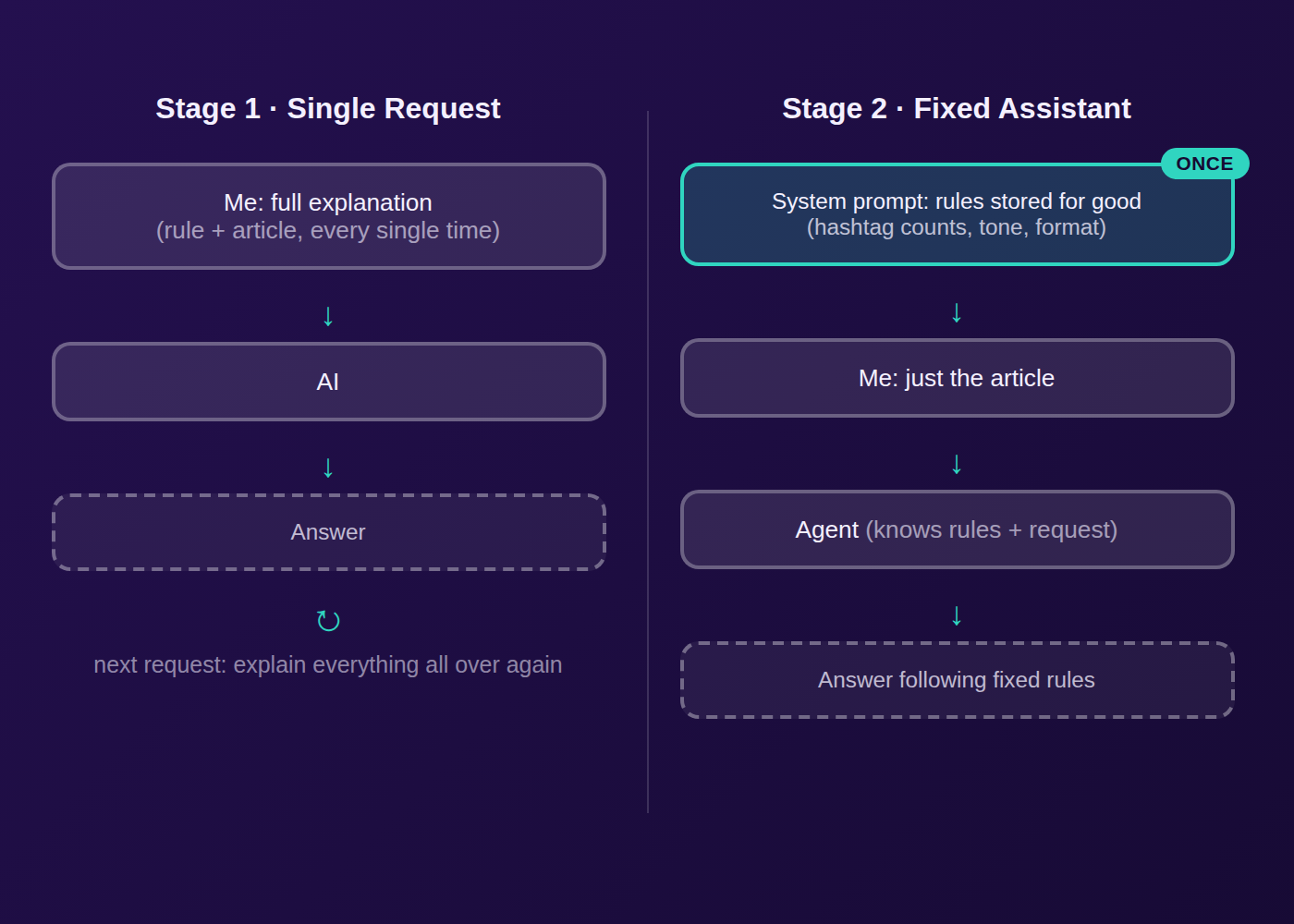
| Before | After | |
|---|---|---|
| Length of my request | Article plus full explanation of the rules | Just the article |
| Where the rule lives | Only in my head | In the agent's system prompt |
| Who "remembers" it | Me, again with every request | The agent, permanently |
What Defines This Stage
For exactly this kind of request – "write me a text, with hashtags", without any role – the MIT autonomy scale from the introductory article has no matching level at all: even its lowest level, A1 Directed, assumes that the AI itself carries out an action that can be approved. The decisive thing about this step is therefore not that the AI becomes more autonomous – at this point it still decides nothing on its own and fetches nothing on its own – but that knowledge moves out of my head into a reusable instruction. A system prompt is an instruction, not a guarantee: it makes the rule more binding than my memory, but whether a text is actually visually striking still has to be judged by someone. At this stage, that someone is still me – the bridge to the review checkpoints that are added in Part 3 and Part 5 of this series.
Still: Every Single Action Gets Approved
What the fixed system prompt does not change: if the agent suggests a text that contains, for example, an overly strong health claim – "helps you lose weight" instead of a neutral wording – I still read it through completely before it goes out. The agent does not decide on its own whether and when something gets published; it suggests, and I decide on every single publication. On the MIT autonomy scale, that is A1 Directed – the AI acts only with direct approval of every single action. The fixed nature of the role changes what the suggestions look like, not who decides in the end.
When This Stage Is Enough – and When It Isn't
What this assistant still lacks is access to real systems: it works exclusively with what is written into its prompt, not with a database, an API or any other real tool. I still have to open, save and insert the featured image for an article myself. Even so, the trade-off at this point is already real: I hand off having to re-explain the tone and the rules with every single request. I keep the approval of every single publication – completely, without exception. It is exactly this remaining problem – the featured image I still move by hand – that Part 2 of this series picks up on: the moment an agent was first able to retrieve real data on its own via a REST API.
Conclusion
A system prompt is documented repetition: anyone who types a sentence for the third time has found their first prompt. This does not yet make the AI more autonomous – it still decides nothing on its own – but for the first time, my own effort shifts from repetition to oversight. That is the real first stage: not a smarter model, but the moment I stop repeating myself.
- Internal pipeline documentation (
coordinator/social/tools/README.md) on the social media workflows of ketovavaria.de, as of November 2026 - See also the introductory article The Stages of AI Use for the complete list of sources for the four frameworks (OpenAI/Bloomberg, Gartner, Microsoft, assecor, MIT Media Lab)